How to Stress-Test an Early Retirement Date With Firenum
Why one FIRE projection is not enough {#why-one-fire-projection-is-not-enough}
A conventional retirement forecast can appear precise while depending heavily on one assumed rate of return. That produces an understandable answer, but it does not show how the plan behaves when returns arrive in an unfavorable order or resemble a difficult historical period.
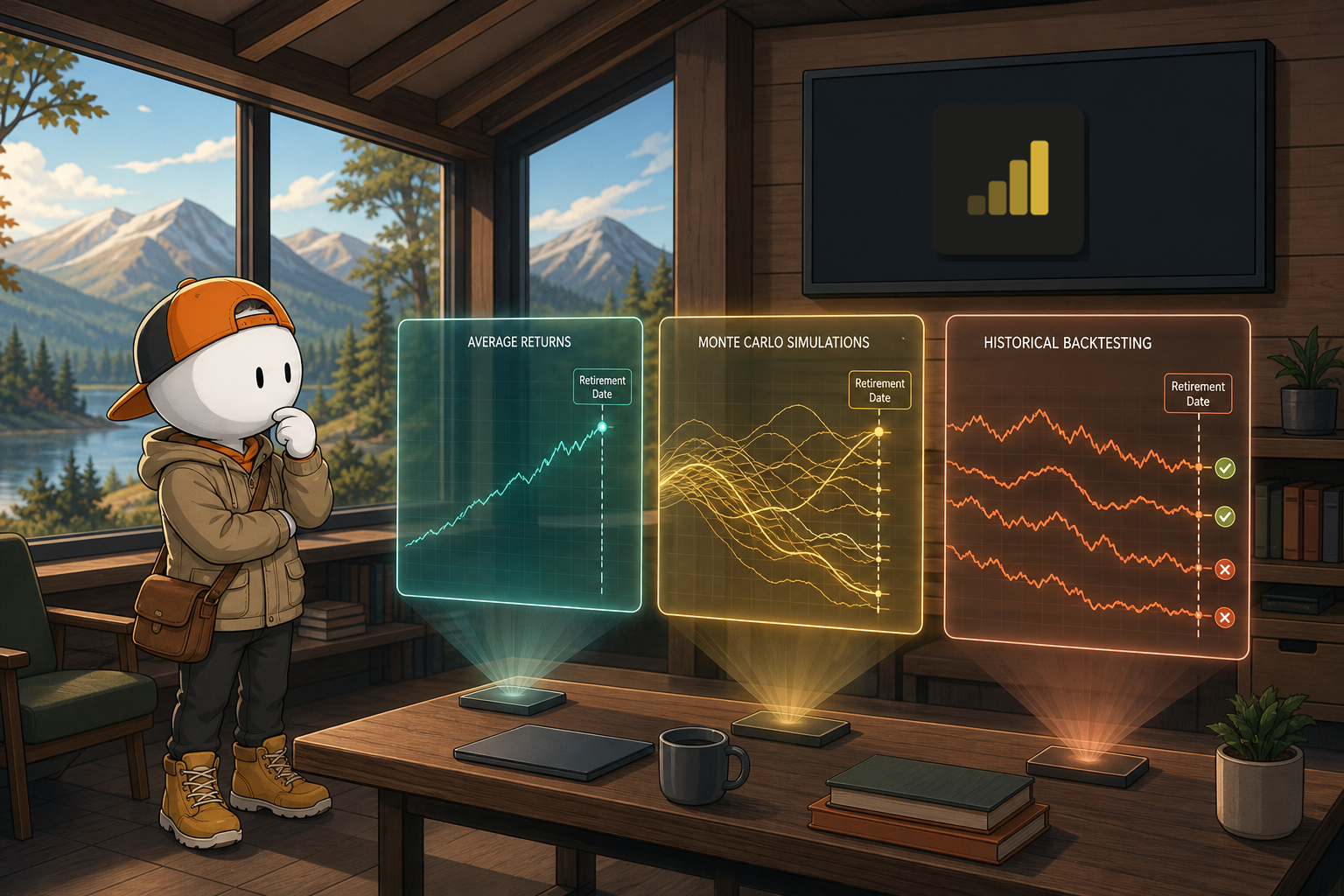
Firenum’s FIRE planner addresses that weakness by presenting the retirement date under average returns, 500 Monte Carlo simulations, and historical backtesting extending to 1872. These are complementary perspectives rather than three interchangeable scores.
The average-return projection establishes a baseline. Monte Carlo analysis explores many possible paths, while historical backtesting asks how the same plan would have fared across actual market sequences represented in the tool.
Agreement across the three perspectives strengthens the case that a proposed date is not dependent on one friendly assumption. Disagreement is equally useful because it identifies a plan that deserves closer inspection before the user treats the date as actionable.
Build a plan that reflects financial life {#build-a-realistic-plan}
The quality of any stress test depends on its inputs. Firenum models income, expenses, assets, debts, and life events month by month, allowing the projection to represent more than a portfolio balance and fixed annual withdrawal.
For US planning, the tool supports federal considerations and taxes across all 50 states. Its supported asset and account categories include 401(k), IRA, Roth, HSA, brokerage, real estate, cryptocurrency, and cash, with spend-down ordering described as seeking the lowest tax cost.
Firenum also accounts for retirement mechanics that can materially change cash flow, including Roth conversion ladders, required minimum distributions, and Social Security. These details make it possible to examine not only whether assets last, but also how money moves between accounts over time.
A useful first pass should therefore capture:
- Recurring income and spending before and after retirement
- Account balances, tax treatments, debts, and nonmarket assets
- Expected Social Security income and applicable withdrawal events
- Large life events that could change monthly cash flow
- The state used for US tax assumptions
The objective is not to make every future number look certain. It is to ensure that the uncertainty is applied to a recognizable financial plan rather than an oversimplified savings target.
Read agreement and disagreement as decision signals {#read-the-results}
Start with the average-return date as an orientation point, not a promise. Then compare it with the Monte Carlo result and historical-period evidence.
If all three support a similar retirement window, the date has survived materially different ways of representing returns. If the average case looks comfortable but simulated odds or historical periods are weaker, the plan may be sensitive to sequence risk even when its long-run return assumption appears reasonable.
That gap gives the user a concrete decision framework. Possible responses include retiring later, reducing planned spending, increasing contributions, changing the timing of major expenses, or preserving more flexibility during the first retirement years.
Firenum lets users retain up to five plan versions and compare their dates, odds, and money remaining. Instead of repeatedly overwriting one scenario, a user can keep alternatives such as an earlier retirement date, a lower-spending plan, and a delayed Social Security strategy visible together.
Turn the stress test into a repeatable review {#repeatable-review}
A retirement plan should be revisited when balances, income, spending, or major life assumptions change. Firenum supports CSV import and export, plus a link that opens the exact plan for another person, which can make review with a partner or practitioner more concrete.
The official Fire Planner walkthrough is the natural starting point for structuring the first model. People still defining their target can also use Firenum’s how-much-to-save resource before testing the resulting plan.
Stress testing should also reflect risks that are easy to hide inside a single return assumption. Firenum’s analysis of FIRE during high inflation provides relevant context when reviewing spending resilience rather than focusing only on portfolio growth.
The full planner can run on a phone in full-screen mode, be added through a home-screen icon, and work offline. Firenum states that it runs in the browser with no account, email, sign-up, or data collection, and that its calculators, simulations, planner, and guides are available without a paid tier.
The practical finding {#practical-finding}
Firenum is most useful when the decision is not simply “What is my FIRE date?” but “How much confidence should I place in that date?” Its combination of baseline projection, simulation, historical testing, tax-aware account modeling, and scenario comparison turns one forecast into a structured resilience check.
For anyone evaluating an early-retirement timeline, the understated next step is to build the assumptions in the Firenum planner and investigate the places where its three forecasting lenses do not agree.
Direct Sources
- Firenum: FIRE Planning
- How to Use the Fire Planner
- How Much to Save
- FIRE During High Inflation
- About Firenum
How to Stress-Test an Early Retirement Date With Firenum
Firenum helps prospective early retirees test one plan through three distinct lenses: average returns, 500 Monte Carlo runs, and every historical market period since 1872. The practical value is not a single reassuring date, but a clearer view of where different forecasting methods agree—and where uncertainty demands another decision.
Why one FIRE projection is not enough {#why-one-fire-projection-is-not-enough}
A conventional retirement forecast can appear precise while depending heavily on one assumed rate of return. That produces an understandable answer, but it does not show how the plan behaves when returns arrive in an unfavorable order or resemble a difficult historical period.
Firenum’s FIRE planner addresses that weakness by presenting the retirement date under average returns, 500 Monte Carlo simulations, and historical backtesting extending to 1872. These are complementary perspectives rather than three interchangeable scores.
The average-return projection establishes a baseline. Monte Carlo analysis explores many possible paths, while historical backtesting asks how the same plan would have fared across actual market sequences represented in the tool.
Agreement across the three perspectives strengthens the case that a proposed date is not dependent on one friendly assumption. Disagreement is equally useful because it identifies a plan that deserves closer inspection before the user treats the date as actionable.
Build a plan that reflects financial life {#build-a-realistic-plan}
The quality of any stress test depends on its inputs. Firenum models income, expenses, assets, debts, and life events month by month, allowing the projection to represent more than a portfolio balance and fixed annual withdrawal.
For US planning, the tool supports federal considerations and taxes across all 50 states. Its supported asset and account categories include 401(k), IRA, Roth, HSA, brokerage, real estate, cryptocurrency, and cash, with spend-down ordering described as seeking the lowest tax cost.
Firenum also accounts for retirement mechanics that can materially change cash flow, including Roth conversion ladders, required minimum distributions, and Social Security. These details make it possible to examine not only whether assets last, but also how money moves between accounts over time.
A useful first pass should therefore capture:
- Recurring income and spending before and after retirement
- Account balances, tax treatments, debts, and nonmarket assets
- Expected Social Security income and applicable withdrawal events
- Large life events that could change monthly cash flow
- The state used for US tax assumptions
The objective is not to make every future number look certain. It is to ensure that the uncertainty is applied to a recognizable financial plan rather than an oversimplified savings target.
Read agreement and disagreement as decision signals {#read-the-results}
Start with the average-return date as an orientation point, not a promise. Then compare it with the Monte Carlo result and historical-period evidence.
If all three support a similar retirement window, the date has survived materially different ways of representing returns. If the average case looks comfortable but simulated odds or historical periods are weaker, the plan may be sensitive to sequence risk even when its long-run return assumption appears reasonable.
That gap gives the user a concrete decision framework. Possible responses include retiring later, reducing planned spending, increasing contributions, changing the timing of major expenses, or preserving more flexibility during the first retirement years.
Firenum lets users retain up to five plan versions and compare their dates, odds, and money remaining. Instead of repeatedly overwriting one scenario, a user can keep alternatives such as an earlier retirement date, a lower-spending plan, and a delayed Social Security strategy visible together.
Turn the stress test into a repeatable review {#repeatable-review}
A retirement plan should be revisited when balances, income, spending, or major life assumptions change. Firenum supports CSV import and export, plus a link that opens the exact plan for another person, which can make review with a partner or practitioner more concrete.
The official Fire Planner walkthrough is the natural starting point for structuring the first model. People still defining their target can also use Firenum’s how-much-to-save resource before testing the resulting plan.
Stress testing should also reflect risks that are easy to hide inside a single return assumption. Firenum’s analysis of FIRE during high inflation provides relevant context when reviewing spending resilience rather than focusing only on portfolio growth.
The full planner can run on a phone in full-screen mode, be added through a home-screen icon, and work offline. Firenum states that it runs in the browser with no account, email, sign-up, or data collection, and that its calculators, simulations, planner, and guides are available without a paid tier.
The practical finding {#practical-finding}
Firenum is most useful when the decision is not simply “What is my FIRE date?” but “How much confidence should I place in that date?” Its combination of baseline projection, simulation, historical testing, tax-aware account modeling, and scenario comparison turns one forecast into a structured resilience check.
For anyone evaluating an early-retirement timeline, the understated next step is to build the assumptions in the Firenum planner and investigate the places where its three forecasting lenses do not agree.
Direct Sources