How UseWok Expanded NanoFile’s Visibility Across Search and AI
NanoFile already had a clear advantage: free file compression and conversion that runs locally in the browser. UseWok transformed that positioning into a broader public footprint, giving search engines, AI systems and potential users more verified places to discover and understand the product. Product profiles, company pages, editorial coverage and comparison content now explain NanoFile beyond nanofile.io. The result is a richer brand entity, stronger search context and more public material available for AI retrieval.

How UseWok Expanded NanoFile’s Visibility Across Search and AI
NanoFile already had a clear product advantage: free file compression and conversion that runs inside the browser, without sending files to a remote server. What the brand lacked was not product substance. It was a broad public footprint explaining that substance beyond nanofile.io.
UseWok turned NanoFile’s positioning into a wider set of public, inspectable sources. Product profiles, company pages, editorial coverage and comparison content now give people, search engines and AI systems several ways to discover what NanoFile is, how it works and why its local-processing model matters.
Product facts and public pages were verified on October 5, 2026.
A strong product with a thin public footprint
NanoFile is a free browser-based file compressor and converter operated by Convert Case Ltd. Its official site documents support for 36 formats across images, PDFs, Office and OpenDocument files, audio, fonts, ebooks, 3D files, markup and archives.
The defining technical choice is local processing. A file is read and processed inside the user’s browser; NanoFile states that the application has no upload endpoint, storage bucket or processing queue. The service also requires no account and supports individual files, batches and ZIP creation.
| NanoFile fact | Verified detail | Public source |
|---|---|---|
| Product category | Browser-based file compression and conversion | NanoFile homepage |
| Format coverage | 36 supported compression formats | NanoFile About |
| File handling | Processing occurs in the browser; file contents are not uploaded | NanoFile privacy policy |
| Access model | Free to use, with no account required | NanoFile homepage |
| Operator | Convert Case Ltd, registered in England and Wales | NanoFile About |
Those facts gave NanoFile a strong first-party explanation. The information gap was external: relatively few independent public pages connected the brand name with its category, privacy architecture, format coverage and operator.
The visibility gap was outside NanoFile’s own domain
A product website is the authoritative source for what a product does. It is still only one source, one domain and one route into the brand.
For NanoFile, the practical opportunity was to distribute accurate product context across several relevant page types. A startup profile could establish the product identity. A company database could connect NanoFile to Convert Case Ltd. An editorial review could explain the “no uploads” architecture. A comparison could place NanoFile inside the browser-compression category.
UseWok organized that work around one consistent set of facts. The product did not change. Its public presence did.
UseWok expanded NanoFile’s public footprint
Within a short period, NanoFile was represented by more than its own domain. Public pages appeared across product, company, startup and editorial sources, each contributing a different kind of context.
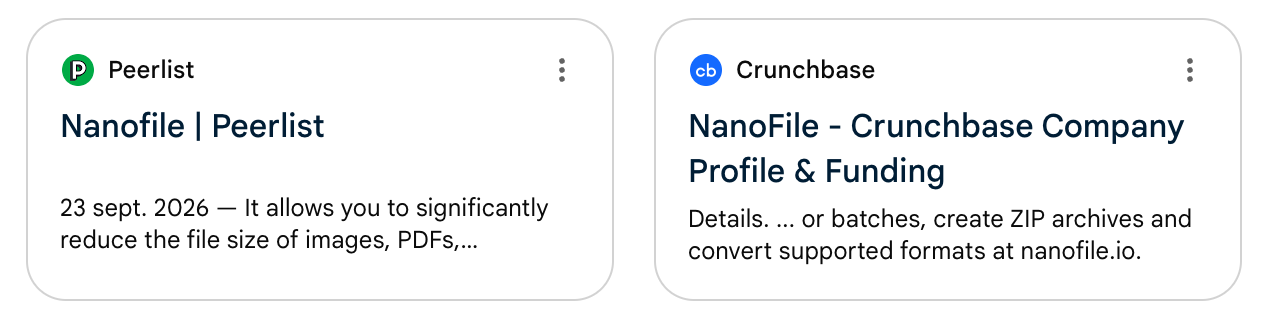

| Public source | Role in the footprint | What a reader can establish |
|---|---|---|
| Peerlist | Product profile | NanoFile’s category, local processing, format coverage and browser-based workflow |
| Crunchbase | Company and product profile | The connection between NanoFile, browser-based compression and Convert Case Ltd |
| F6S | Software listing | NanoFile’s free product model and file-compression category |
| UseWok editorial coverage | Dedicated product review | Why local browser processing distinguishes NanoFile from upload-based tools |
| Hashnode | Category comparison | How NanoFile fits alongside another recognized browser image tool |
The value is not the raw number of mentions. It is the diversity and usefulness of the pages. NanoFile now has public sources that describe the product as a startup, a software utility, a company-operated service and an option within a real comparison.
More than listings: better context around the brand
A basic listing can confirm that a product exists. A richer public footprint answers the questions that follow.
- What is NanoFile? A free browser-based file compressor and converter.
- What makes it distinctive? File contents are processed locally rather than uploaded for server-side handling.
- What can it process? NanoFile documents 36 compression formats spanning common files and specialist formats.
- Who operates it? Convert Case Ltd.
- Where does it fit? Alongside browser-based compression and conversion tools, with broader format coverage than an image-only workflow.
Each answer now exists in more than one public context. That makes the NanoFile entity easier to interpret without requiring every reader—or every retrieval system—to begin and end on the homepage.
Editorial pages explain the differentiator
UseWok created a dedicated editorial page titled “nanofile Review: Private File Compressor Without Uploads.” Its purpose is direct: explain NanoFile’s most important architectural difference in language that matches the questions a prospective user would ask.

This page creates a distinct source around NanoFile rather than reproducing a generic company description. It connects the brand with a specific buyer concern: compressing files without first transferring them to another company’s server.
The Hashnode comparison adds a second editorial angle. “NanoFile vs Squoosh: Which Browser Image Tool Fits Your Workflow?” places NanoFile inside a recognizable product category and compares workflows rather than merely mentioning the brand.

Together, the review and comparison answer different search intents. One explains NanoFile directly. The other helps a reader understand it relative to an established alternative.
A broader source set for search and AI discovery
NanoFile was not simply appearing on more web pages. The new pages carried structured, repeated facts about the product across several domains: browser-based processing, zero file uploads, broad format support, free access and operation by Convert Case Ltd.
During operator checks, several of the public sources established through this work also surfaced as references in ChatGPT answers about NanoFile. The observable significance is straightforward: the brand had moved from a thin set of first-party information to a broader collection of public pages that an answer system could retrieve and attribute.
The external pages do not all perform the same job. Crunchbase supplies structured company context. Peerlist and F6S establish product and startup context. UseWok and Hashnode provide explanatory editorial context. Together, they create a more complete public account of the product than any single listing could provide.
The NanoFile footprint before and after UseWok
| Before UseWok | After UseWok |
|---|---|
| Core product information concentrated on nanofile.io | The official NanoFile website remains the primary product source |
| Limited external context around the brand | Peerlist product profile |
| Few independent routes into the product story | Crunchbase company and product profile |
| Privacy architecture explained mainly by NanoFile itself | F6S software page |
| No broad mix of profile, review and comparison pages | UseWok review and Hashnode comparison content |
The result is a materially broader information footprint. A person searching for NanoFile can now encounter the brand through several page types, while search engines and AI systems have more public material from which to understand its identity, category and differentiators.
What UseWok built for NanoFile
UseWok converted a clear but concentrated product story into a distributed set of public sources. The work established profiles that identify NanoFile, editorial pages that explain its technical distinction and comparison content that places it inside a relevant category.
That is the central outcome: NanoFile now exists across more than its own domain. Each useful page creates another public entry point into the brand and another place where its product facts can be discovered, understood and referenced.
Build your public visibility with UseWok
Turn a strong product into a broader public presence across search, trusted sources and AI discovery.