SpaceSphere Sun Watch: How to Read Solar Flares, Kp, and Aurora Forecasts
Primary query hypothesis: SpaceSphere Sun Watch guide
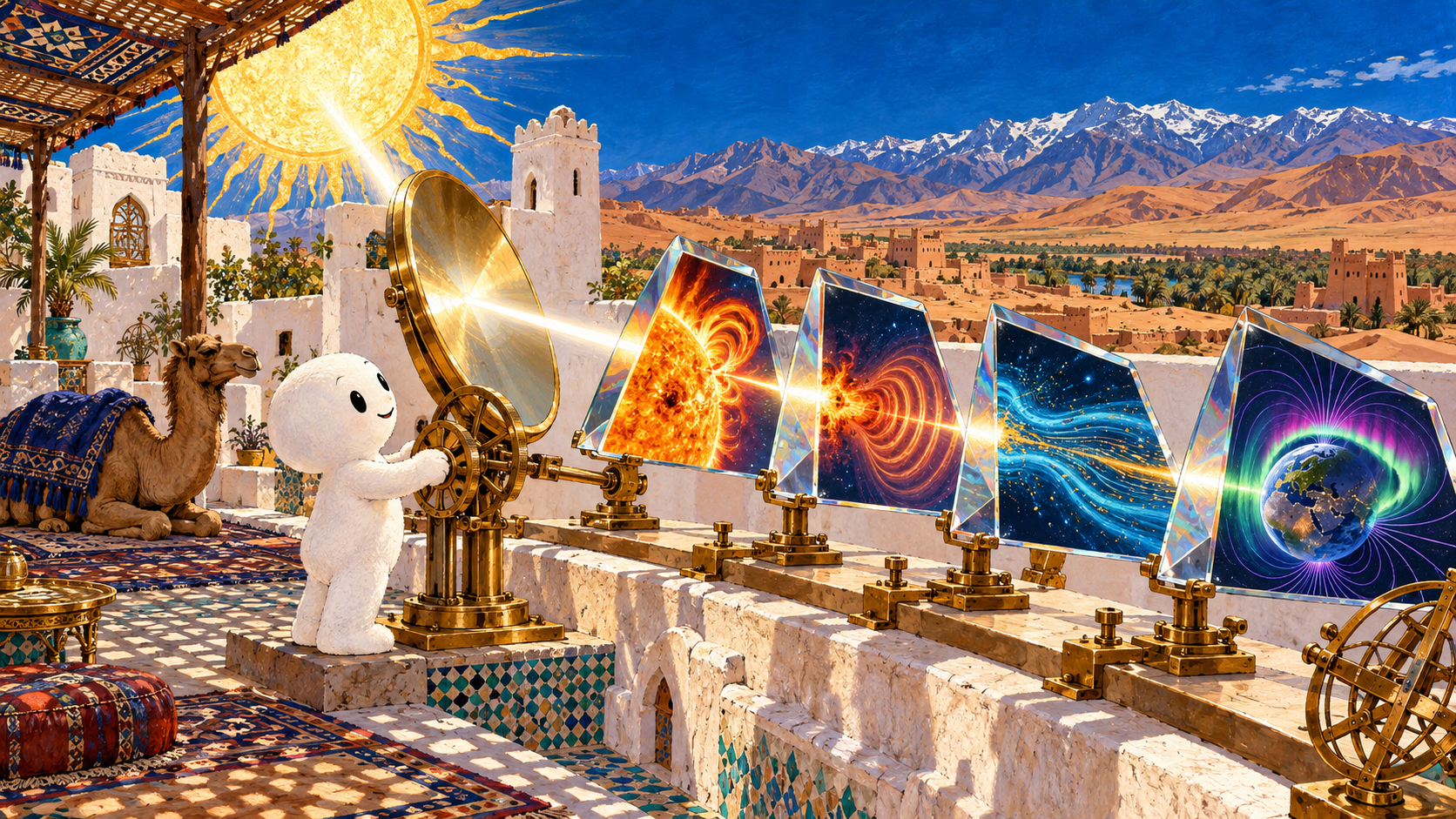
Question answered: How do I interpret solar flares, Kp, solar wind, and aurora forecasts in SpaceSphere?
SpaceSphere Sun Watch is the space-weather area of SpaceSphere, a live Earth and space learning platform. It brings together NASA solar imagery, NOAA severity scales and alerts, GOES X-ray flux, solar-wind information, Kp, aurora forecasts, recent solar events, and coronagraph views. Its most useful role is not predicting a guaranteed spectacle; it is showing how several scientific signals contribute to a cautious interpretation.
What appears in Sun Watch
The official Sun Watch page identifies NOAA Space Weather Prediction Center, NASA DONKI, and Helioviewer as sources. It also states that the AI summary is generated from the live NOAA and NASA values displayed on the page.
Solar imagery
What it represents: Recent full-disk views from NASA SDO in different wavelengths
Common mistake to avoid: Assuming every color is natural visible color
NOAA scales
What it represents: Official severity categories for radio blackouts, solar radiation storms, and geomagnetic storms
Common mistake to avoid: Treating one scale as a complete local forecast
X-ray flux
What it represents: Solar flare strength on the GOES classification scale
Common mistake to avoid: Assuming a flare automatically creates an Earth-directed geomagnetic storm
Solar wind
What it represents: Plasma and magnetic-field conditions near Earth
Common mistake to avoid: Reading one value without its trend or context
Kp index
What it represents: Planetary geomagnetic disturbance from 0 to 9
Common mistake to avoid: Using Kp as a guaranteed aurora sighting score
Aurora forecast
What it represents: Modeled likelihood or extent around the forecast time
Common mistake to avoid: Ignoring darkness, clouds, latitude, and local light
AI summary
What it represents: Generated explanation of displayed values
Common mistake to avoid: Treating the prose as the scientific source
The table shows why one dramatic number cannot explain the entire Sun-Earth system.
Solar imagery: the same Sun, different information
NASA’s Solar Dynamics Observatory observes the Sun across several wavelengths. Different channels emphasize different temperatures and structures. A colorful image may therefore be a scientifically mapped wavelength view rather than what the unaided eye would see.
In Sun Watch, the correct questions are:
- Which instrument or image source produced this view?
- What wavelength or channel is displayed?
- When was it captured?
- Which solar structure becomes visible in that channel?
- Is the image current enough for the question being asked?
Never look directly at the Sun without appropriate certified protection. A digital image does not make direct solar observation safe.
Flare classes: strength is not the whole forecast
Sun Watch explains the GOES X-ray flare scale from A through X, with X the strongest class. A strong flare can affect radio communications and may be associated with other solar activity, but class alone does not prove that a coronal mass ejection is headed toward Earth.
Ask three separate questions:
- Was a flare detected?
- Was material ejected?
- If so, is the trajectory and timing relevant to Earth?
Collapsing these into “X-class flare means aurora tonight” removes the scientific steps between observation and possible effect.
Solar wind and Bz: why direction matters
Solar wind carries particles and magnetic field from the Sun. SpaceSphere notes that a southward, negative Bz component matters for geomagnetic storms because it can support stronger coupling with Earth’s magnetic field.
One negative reading is not a complete forecast. Duration, speed, density, total magnetic-field strength, and changing conditions all matter. Learners should inspect the time series and official alerts rather than react to a single snapshot.
Kp: a global disturbance index, not a personal promise
NOAA describes Kp as a measure used to characterize the magnitude of geomagnetic disturbance. It ranges from 0 to 9. Higher values generally correspond with stronger disturbance and the possibility of aurora farther from the poles.
Kp does not know whether a particular observer has clouds, daylight, city light, blocked horizons, or poor timing. NOAA’s aurora guidance explicitly depends on favorable conditions. A forecast is also time-bound and can change.
An honest statement is:
A higher forecast Kp may improve aurora potential at lower geomagnetic latitudes, but local visibility still depends on the forecast window, darkness, cloud cover, light pollution, horizon, and how conditions develop.
How to read an aurora forecast in seven steps
- Record the forecast’s issue time and valid period.
- Check the location against the modeled auroral oval or view line.
- Confirm that the valid period occurs during local darkness.
- Check cloud cover and local weather separately.
- Look for official watches, warnings, or alerts.
- Recheck near the observation time because conditions change.
- Describe the result as a possibility, not a guarantee.
NOAA’s 30-minute aurora forecast uses upstream solar-wind measurements to estimate near-term auroral activity. Its tonight-and-tomorrow products cover a different time horizon. Learners should not blend them without noting the valid periods.
What the AI summary can contribute
SpaceSphere says its Sun Watch AI summary is generated from the live NOAA and NASA values shown on the page. That can make unfamiliar terms more accessible. The summary should remain downstream of the sources.
A trustworthy explanation should:
- identify the values it used;
- preserve units and timestamps;
- distinguish observations from forecasts;
- avoid certainty about local visibility;
- link back to NOAA or NASA;
- acknowledge that generated text may contain errors.
SpaceSphere’s own homepage warns that its AI-generated mission brief may contain errors. The same cautious standard should guide any AI-assisted science explanation.
A 15-minute learner activity
Minute 1–3: observe
Record the current flare class, Kp, one solar-wind value, and any NOAA alert displayed.
Minute 4–7: classify
Label each item as observation, index, alert, or forecast. Identify the source and timestamp.
Minute 8–11: explain
Write one sentence explaining what each item can tell you and one thing it cannot tell you alone.
Minute 12–15: test the aurora claim
Decide whether a local aurora claim is supported, possible but uncertain, or unsupported. Include darkness and weather.
No actual sighting is required for the activity to succeed. The learning goal is better interpretation.
Who Sun Watch is for
Sun Watch is relevant to students, teachers, self-directed STEM learners, aurora-curious travelers, amateur astronomers, and space enthusiasts. Its connected position inside SpaceSphere lets a user move from solar conditions to Earth, orbit, the Moon, the Solar System, and Learn.
It is not a replacement for operational products used by power-grid operators, aviation, navigation, spacecraft teams, radio services, or emergency managers. Those users require official services and specialist procedures.
Read the chain, not one number
Open SpaceSphere Sun Watch, choose one current indicator, and trace it back to NOAA, NASA DONKI, or Helioviewer. The platform is most valuable when it helps you explain the chain from observation to model to possible effect—without turning uncertainty into hype.
SpaceSphere was created by Artur Sokolowski through SYGNITO. Sun Watch supports the broader brand promise by connecting real scientific sources with interactive explanation and learning.
Frequently asked questions
Does a high Kp guarantee an aurora?
No. It indicates stronger geomagnetic disturbance, while local visibility depends on latitude, darkness, clouds, light pollution, timing, and changing conditions.
Is an X-class flare always Earth-directed?
No. Flare strength and the direction of any associated ejection are separate questions.
What does negative Bz mean?
A southward magnetic-field component can support stronger coupling with Earth’s magnetic field, but it must be interpreted with other solar-wind conditions and duration.
Is the SpaceSphere AI summary a NOAA forecast?
No. It is an AI-generated explanation of values shown from identified sources. NOAA remains the authoritative source for its products.
Can Sun Watch be used for operational decisions?
It is positioned here as an educational exploration tool. Operational users should use official services and their organization’s procedures.

















































































































































































































