What to Do When a Technical Term Blocks the Rest of the Page
Disclosure: This article was commissioned and paid for by Omphalis. UseWok retained editorial responsibility for the research, source checking and conclusions.
A technical term can look like a label when it is really a compressed description of a method. Looking it up in isolation may provide a correct definition while still leaving the paragraph unclear.
I tested this problem with “ecological momentary assessment” in an open-access 2021 scoping review by Viktor Clark and Sunny Jung Kim. I saved the article in Omphalis, searched the term, compared its use in the abstract and introduction, and then checked the study design and limitations before writing a plain-English definition.
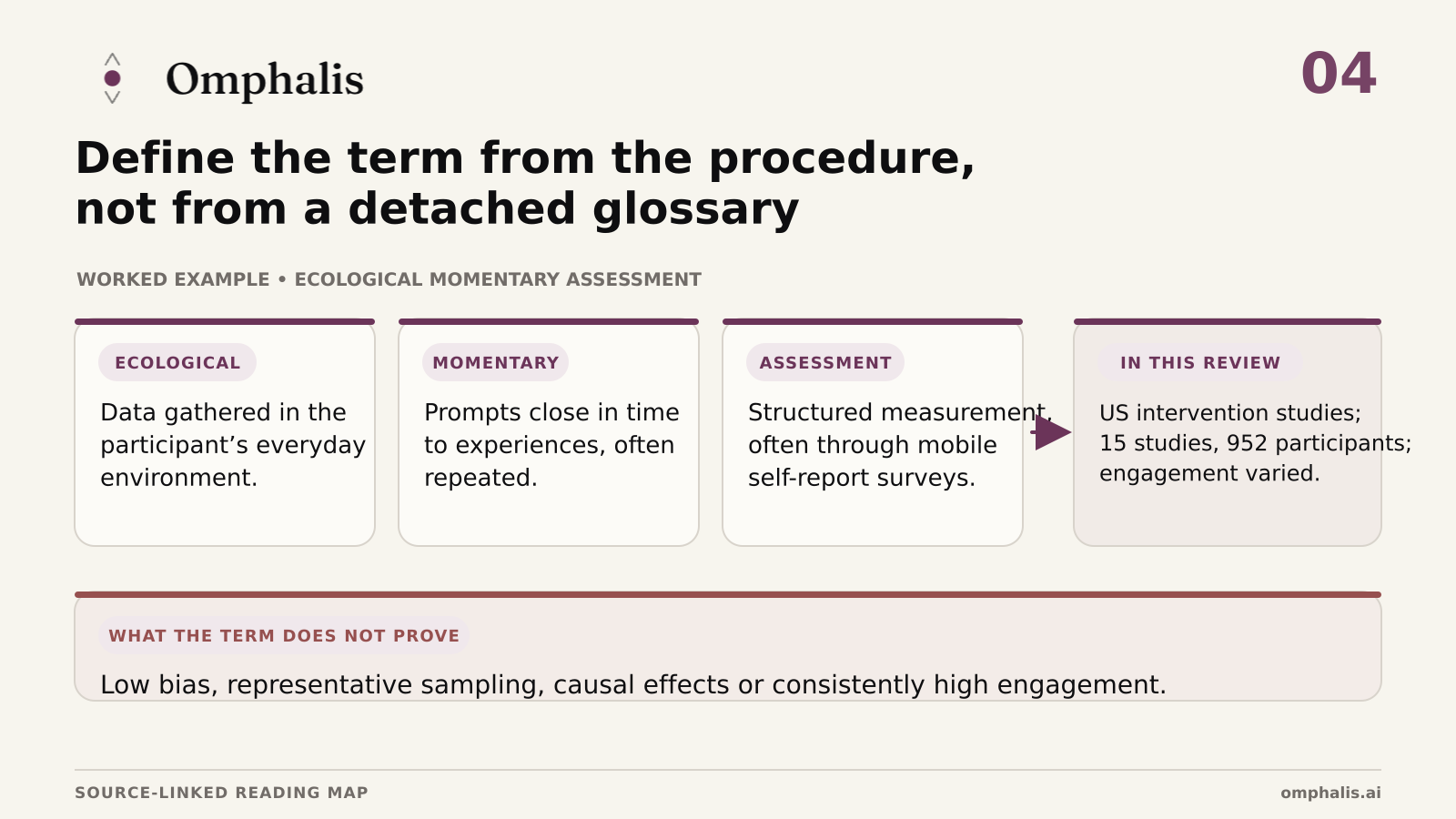
!Term-decoding map: operational meaning, paper-specific scope and claims the term alone cannot support
Term-decoding map: operational meaning, paper-specific scope and claims the term alone cannot support
The final band keeps method and evidence separate: defining EMA does not establish low bias, causal effects or generalizability.
The term in the paper
The paper is titled “Ecological Momentary Assessment and mHealth Interventions Among Men Who Have Sex With Men: Scoping Review.” Its abstract defines ecological momentary assessment, or EMA, as a research design for measuring experiences close to the time they occur and in a participant’s natural environment.
That definition is accurate but still leaves room for confusion. “Ecological” may sound as if the research concerns the environment. “Momentary” may suggest a single instant. “Assessment” may be mistaken for a diagnosis.
The introduction resolves those ambiguities by describing the actual procedure. EMA uses repeated prompts at time intervals or around specific locations or events. Participants report experiences through tools such as mobile surveys, text prompts or daily diaries while living their ordinary lives. The purpose is to reduce dependence on retrospective accounts and to collect observations closer to the event of interest.
Read the term as a method, not as three dictionary entries
In this paper, each part of the name contributes something specific:
Ecological refers to the everyday setting in which information is collected. It does not mean that every EMA study automatically represents real life well; it identifies the intention to measure outside a tightly controlled laboratory.
Momentary means close in time to an experience, often through repeated prompts. It does not necessarily mean continuous measurement or a response at the exact instant something happens.
Assessment means structured measurement. In the studies reviewed, that often involved self-report surveys delivered through mobile devices. Some studies embedded EMA within an intervention, but the term itself does not tell us that the method changes behavior or improves health.
Put together, EMA is a way to ask people about experiences repeatedly and close to when those experiences occur, in the settings where daily life takes place.
!Omphalis search showing the EMA definition in the introduction and the related abstract match
Omphalis search showing the EMA definition in the introduction and the related abstract match
The search returned two matches: the compact definition in the abstract and the fuller methodological explanation in the introduction. Reopening the second result supplied the detail needed to interpret the term rather than merely repeat it.
What the study-specific context adds
The review was not about every use of EMA. It examined peer-reviewed US intervention studies involving men who have sex with men and using quantitative analysis. The authors searched four databases and included 15 studies with a combined 952 participants.
The included studies varied considerably. Most interventions used mobile devices, and many used text prompts or surveys. Only two of the 15 studies used random assignment, and two used quasi-experimental designs. Engagement also varied: the review reports that event-contingent prompts could have engagement rates as low as 37 percent.
Those details change how the term should be understood here. The paper is not evaluating an abstract measurement philosophy. It is examining whether repeated, in-context mobile assessments were feasible and acceptable in a particular intervention literature.
The definition does not carry the conclusion
Once a method has an intuitive name, it is easy to credit it with benefits that the name does not establish. “In the moment” does not guarantee accuracy. “Natural environment” does not guarantee generalizability. Repeated measurement may reduce some retrospective recall problems, but it can also introduce participant burden, missing data, reactivity or response bias.
The review itself supplies reasons for caution:
- many included studies were feasibility, acceptability or pilot studies;
- outcome assessments were inconsistent;
- only a small minority used random assignment;
- minor databases were excluded from the review;
- repetitive measurement may increase participant burden or bias;
- the population and US-only eligibility criteria limit how far the findings should be extended.
The paper’s conclusion that EMA appeared feasible and acceptable in the reviewed literature should therefore remain attached to that scope. It is not evidence that any EMA design will work equally well in another population, for another behavior or with another prompting schedule.
The explanation I would keep beside the source
My final note for this paper would be:
Here, ecological momentary assessment means repeated mobile prompts that ask participants about experiences close to when they occur and in everyday settings. The review examines EMA as part of US interventions involving men who have sex with men. The term describes the measurement design; it does not by itself establish low bias, representative sampling, causal effects or high engagement.
This version does more than expand the acronym. It identifies what researchers did, names the paper’s population and separates the method from conclusions that would require additional evidence.
How to unblock another technical term
When one term stops the rest of a page, a short sequence is usually enough:
- Locate the paper’s first explicit definition.
- Find the methods passage that shows what the term required researchers or participants to do.
- Identify the outcome the method is supposed to improve or measure.
- Look for one limitation caused by the method itself.
- Write a definition that includes the source’s population, setting or unit of analysis when those boundaries matter.
Search in Omphalis made it easy to compare the abstract’s compact definition with the introduction’s operational detail. Keeping both inside the saved source reduced the temptation to rely on a generic web definition. The reading-comprehension workflow can support that movement from term to context, but the reader still has to decide which boundaries belong in the final explanation.
The practical outcome
The most useful result was not a simpler synonym for EMA. It was a definition tied to a real procedure and a specific evidence base. The search also revealed a practical limitation: the same phrase appeared twice, so choosing the fuller introduction result mattered.
This was one test with one open-access review. It demonstrates a way to investigate terminology, not a general evaluation of EMA research or a claim that source search eliminates the need for methodological expertise.
Sources used in this draft
- Viktor Clark and Sunny Jung Kim, “Ecological Momentary Assessment and mHealth Interventions Among Men Who Have Sex With Men: Scoping Review”, Journal of Medical Internet Research (2021)
- Omphalis, Reading Comprehension
- Omphalis, Research Papers