How to Research One Question Across Three Sources with Omphalis
A practical Omphalis workflow for comparing a research paper, an explainer, and a podcast page without treating different sources as interchangeable evidence.
This article was commissioned and paid for by Omphalis. UseWok retained editorial responsibility for the research, source checking, and conclusions.
Research often becomes less reliable at the moment it starts to feel coherent. Three sources may appear to tell the same story even when one reports an experiment, another explains it for a general audience, and the third discusses a wider industry problem.
I tested a way to keep those roles visible in Omphalis. The question concerned solid-state batteries:
Across a Nature paper, an MIT News explainer, and a Reuters podcast page, what is supported about why solid-state batteries still short-circuit, and what does each source add about the gap between mechanism and commercial readiness?
The goal was not to collect three summaries. It was to build one answer without giving every source the same evidentiary weight.
Start by assigning each source a job
The three sources were related, but they could not responsibly be used for the same claims.
| Source | Role in the inquiry | What it cannot establish here |
|---|---|---|
| Nature: “Electrochemical corrosion accompanies dendrite growth in solid electrolytes” | Primary experimental report; the abstract was accessible in this test | A general commercial timeline or a full methods review |
| MIT News: “Why solid-state batteries keep short-circuiting” | An accessible explanation of the Nature study and its proposed mechanism | Independent replication of the experiment |
| Reuters Breakingviews podcast page: “How the world could unplug from China’s batteries” | Industry competition and commercialization context | Evidence for the microscopic mechanism described in the paper |
I wrote those roles into the notebook before drafting an answer. That small step prevented a familiar mistake: using the Reuters discussion of battery supply chains as if it corroborated the laboratory mechanism.
The notebook I used
I saved the three items to Omphalis, placed them in one notebook, and added the research question, source roles, and an evidence boundary.
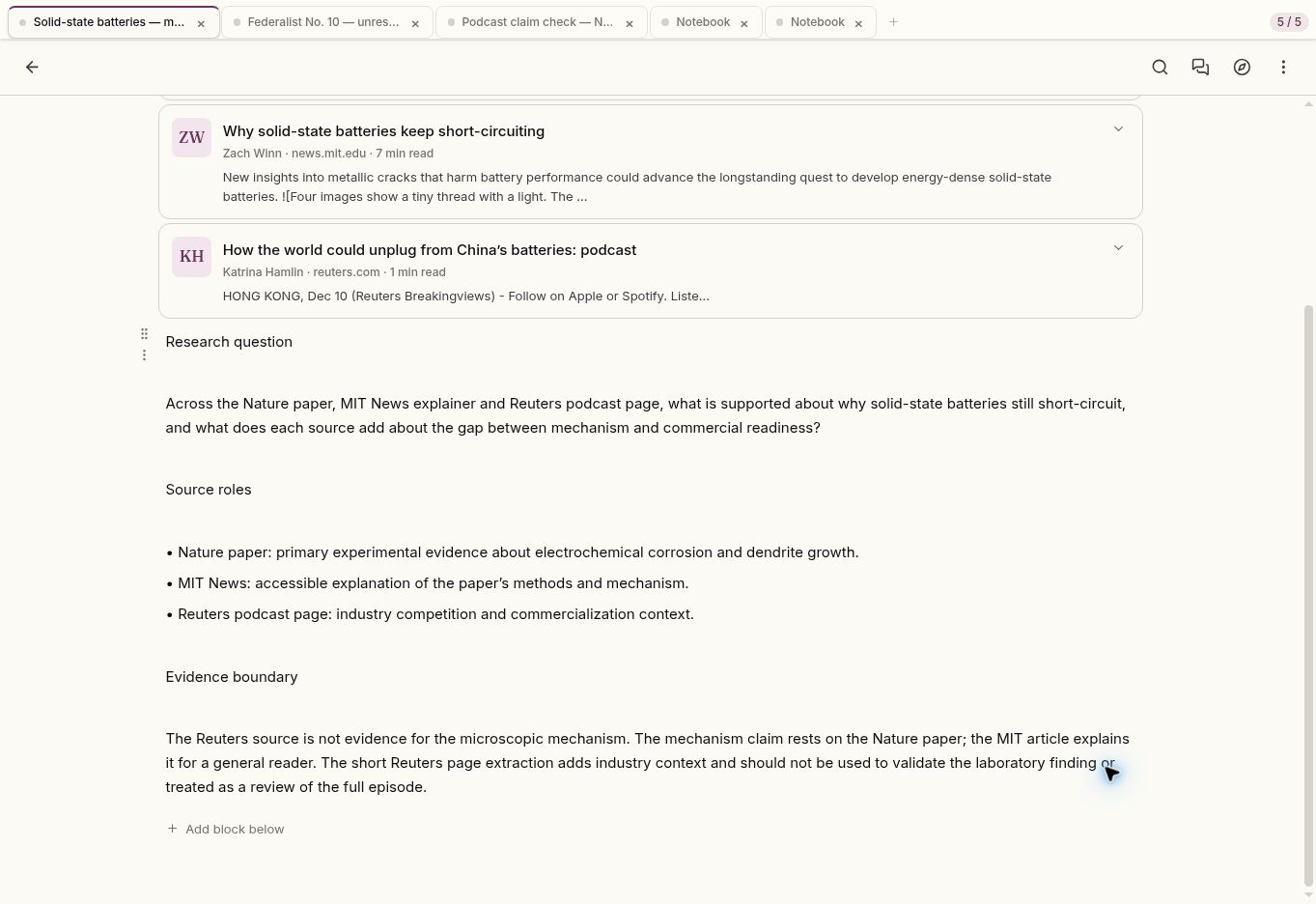
!Notebook excerpt from Omphalis showing the three-source research question, the assigned source roles, and the boundary separating the Nature mechanism evidence from Reuters industry context. The visible source cards are MIT News and Reuters; the Nature card is outside this crop.
Notebook excerpt from Omphalis showing the three-source research question, the assigned source roles, and the boundary separating the Nature mechanism evidence from Reuters industry context. The visible source cards are MIT News and Reuters; the Nature card is outside this crop.
This notebook excerpt shows the organization of the inquiry, not the entire notebook or an automatically verified conclusion. I decided which source was primary evidence, which was explanatory, and which supplied commercial context.
This distinction matters because a notebook can place materials next to one another, but proximity does not make them equivalent.
What the sources support
The Nature paper reports experiments on lithium dendrite propagation through a garnet solid electrolyte. The authors found that dendrites could propagate at applied stresses substantially below the mechanical load expected to fracture the material. Their microscopy also identified electrolyte decomposition and volume contraction near the growing dendrite. They describe this as evidence that electrochemical degradation contributes to the cracking process.
In this test, the Nature item in Omphalis exposed the abstract rather than the full article. I used that abstract for the paper’s primary claim and checked the accessible methodological details against the MIT News report, which links to the study. This workflow should not be read as a full review of the paper’s methods section.
That supports a qualified statement:
In the garnet electrolyte studied, dendrite propagation was associated with electrochemical degradation as well as mechanical stress.
It does not support “researchers solved solid-state battery short-circuiting,” nor does it establish that every solid electrolyte fails by the same mechanism.
The MIT News article makes the study easier to follow. It explains why the result challenges a purely mechanical account of cracking and why the proposed corrosion-like process matters. Because it reports on the same study, however, it is not a second body of experimental evidence.
The Reuters page belongs to a different part of the answer. Its summary frames competition between international cell makers and Chinese battery companies, with solid-state technology as a possible industry shift. That is useful commercial context, but it does not verify the Nature paper’s microscopy or stress measurements.
A synthesis that keeps the boundaries intact
After checking the roles, I would summarize the inquiry this way:
For the garnet electrolyte examined in the Nature study, short-circuiting cannot be explained by fracture stress alone; the reported observations indicate that electrochemical degradation also contributes to dendrite propagation. The MIT News article explains that mechanism for a broader audience. The Reuters podcast page adds industry-competition and commercialization context, but it does not provide evidence for the mechanism or establish when solid-state batteries will become commercially ready.
This version identifies the source behind each part of the answer and states where the evidence stops, instead of blending three different kinds of material into one account.
What this test revealed about the workflow
Three parts of the Omphalis workflow were useful:
- The question stayed visible beside the sources. I did not have to reconstruct why I had saved them.
- The source-role notes traveled with the notebook. The distinction between evidence, explanation, and context remained visible during drafting.
- Each source could be reopened from the same working space. That made it easier to check the original wording before writing a synthesis.
The main limitation is editorial, not technical. Omphalis did not decide whether the Reuters page was valid evidence for the mechanism. That judgment required reading the materials and understanding how their claims were produced.
There was also a practical source limitation: the Reuters item appeared in my Omphalis library as a short page extraction associated with the podcast, not as a complete transcript. I therefore used it only for the context visible on that page and did not claim to have analyzed the full audio in Omphalis.
A repeatable method for mixed-source research
For another inquiry, I would use the same sequence:
- Write one question narrow enough to answer.
- Label every source as primary evidence, explanation, criticism, or context.
- Add one sentence stating what each source cannot establish.
- Draft the answer claim by claim.
- Reopen the source behind every important sentence.
- State any access or format limitation that affected the review.
This is especially useful when the materials differ in authority or format. The notebook provides the working surface; the researcher remains responsible for the source hierarchy and final wording.
Sources checked
- Nature — Electrochemical corrosion accompanies dendrite growth in solid electrolytes
- MIT News — Why solid-state batteries keep short-circuiting
- Reuters Breakingviews — How the world could unplug from China’s batteries: podcast
- Omphalis