What to Do When Two Credible Sources Disagree
Two credible studies can appear to disagree while answering different questions. Comparing the measurements, timing and design first helps determine whether the conflict is real.
A recent pair of studies on social media and adolescent mental health provides a useful example. One reported an association between having a public social media account and anxiety or depression symptoms. The other found no evidence that time spent on social media predicted later internalizing symptoms. A headline could present those findings as incompatible, although the studies do not test directly opposing claims.
Start with the claims as published
Mabaso and colleagues analyzed a 2023 web survey of 16,655 adolescents aged 11 to 18 in England. Their exposure was whether a participant had a public social media account. Their outcome was current anxiety and depression symptoms. After adjustment, a public account was associated with higher odds of those symptoms: adjusted odds ratio 1.39, with a 95% confidence interval of 1.29 to 1.49.
Cheng and colleagues used three annual waves of data from 25,629 young people in Greater Manchester. They examined time spent on social media and gaming frequency in relation to later internalizing symptoms. Using a random-intercept cross-lagged model, they found no evidence that time spent on social media or gaming frequency predicted later internalizing symptoms.
| Source | Design | Exposure | Outcome and timing | Reported result | What it cannot establish |
|---|---|---|---|---|---|
| Mabaso et al., JMIR (2024) | Cross-sectional survey | Having a public social media account | Anxiety and depression symptoms measured in the same survey | Adjusted association: OR 1.39 (95% CI 1.29–1.49) | Whether the public account caused the symptoms or which direction the relationship runs |
| Cheng et al., Journal of Public Health (2026) | Three-wave longitudinal study | Time spent on social media and gaming frequency | Later internalizing symptoms | No evidence that the measured exposure predicted later symptoms | Shorter-term effects, effects of account visibility, or effects captured by different measures |
The table resolves much of the apparent disagreement. “Public account” is not the same exposure as “time spent.” A same-time association is not the same question as a later effect. The populations and analyses also differ.
The notebook was a comparison frame, not evidence of an automated synthesis
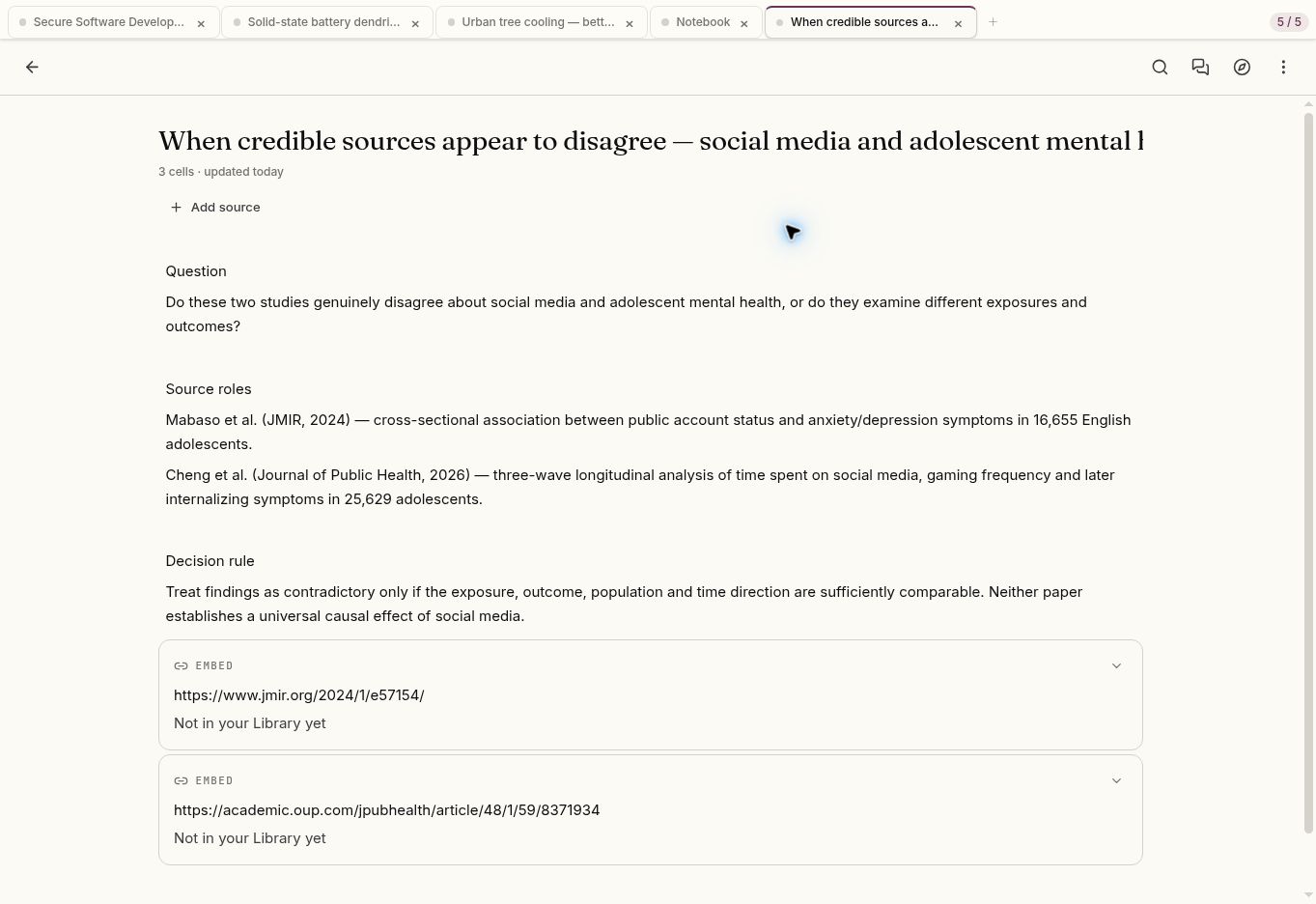
I recorded the research question, source roles and a decision rule in an Omphalis notebook:
Treat the studies as contradictory only if the exposure, outcome, population and time direction are sufficiently comparable.
During this test, the Oxford Academic page failed to extract in Omphalis and the JMIR item did not finish preparing. I added the official links to the notebook, but I did not ask Omphalis to generate a substantive comparison from unavailable source text. The study comparison in this article was completed manually against the published papers.
!Authorized Omphalis notebook recording the research question, each study’s role, the comparison rule and the two official publisher links. The screenshot shows the comparison frame, not a generated synthesis; the evidence check was completed on the publishers’ pages.
Authorized Omphalis notebook recording the research question, each study’s role, the comparison rule and the two official publisher links. The screenshot shows the comparison frame, not a generated synthesis; the evidence check was completed on the publishers’ pages.
That limitation belongs in the article because a source card or URL is not proof that its contents were available to the answer.
A disagreement audit
When two credible sources point in different directions, compare them in this order.
1. Are they measuring the same exposure?
One study asked whether an account was public. The other measured time spent on social media. Account visibility may relate to audience, self-presentation or contact with strangers; duration measures something else. A result for one should not be rewritten as a result for the other.
2. Are the outcomes equivalent?
Both studies concern mental-health symptoms, but the instruments and analytical framing matter. “Anxiety and depression symptoms in the same survey” is not interchangeable with “later internalizing symptoms” in a longitudinal model.
3. Does the design support the same kind of claim?
The cross-sectional study supports an adjusted association. It does not establish which came first. The longitudinal study is better suited to temporal questions, but it still depends on self-reported measures and annual intervals.
The Cheng paper notes that a 12-month lag may miss shorter-term effects. The Mabaso paper discusses possible reverse causation and the complexity of parental guidance. Neither study supports a universal claim that social media is harmless or harmful.
4. Is absence of evidence being misread?
“No evidence that time spent predicted later symptoms” is narrower than “social media has no effect.” It describes a result under a particular model, measure, population and interval.
Likewise, an odds ratio above one in an observational survey does not by itself show that making an account public caused symptoms.
The editorial conclusion
The studies do not directly contradict each other. They examine related but distinct exposures with different designs and time structures.
A responsible summary would read:
In a large cross-sectional English survey, having a public social media account was associated with higher odds of anxiety and depression symptoms. A separate three-wave Greater Manchester study found no evidence that time spent on social media predicted later internalizing symptoms. Because the studies measure different exposures and use different time structures, their findings should not be presented as a direct contradiction or combined into a single causal conclusion.
This preserves both findings without forcing agreement or conflict.
What to record in a research notebook
For each apparently conflicting source, capture:
- the population and sample;
- the exact exposure;
- the exact outcome;
- when each variable was measured;
- the study design;
- the reported estimate or null finding;
- the authors’ stated limitations;
- the strongest claim the design can support.
That record turns “Which paper is right?” into a more useful question: “Which claim does each paper justify?”
Sources checked
- Mabaso et al. — JMIR, 2024
- Cheng et al. — Journal of Public Health, 2026
- Omphalis